Note 01 / rig structure
How to read a lateen sail from shore
Begin with five visible parts—mast, yard, cloth, controlling lines and hull—before turning a triangular silhouette into a claim about movement.
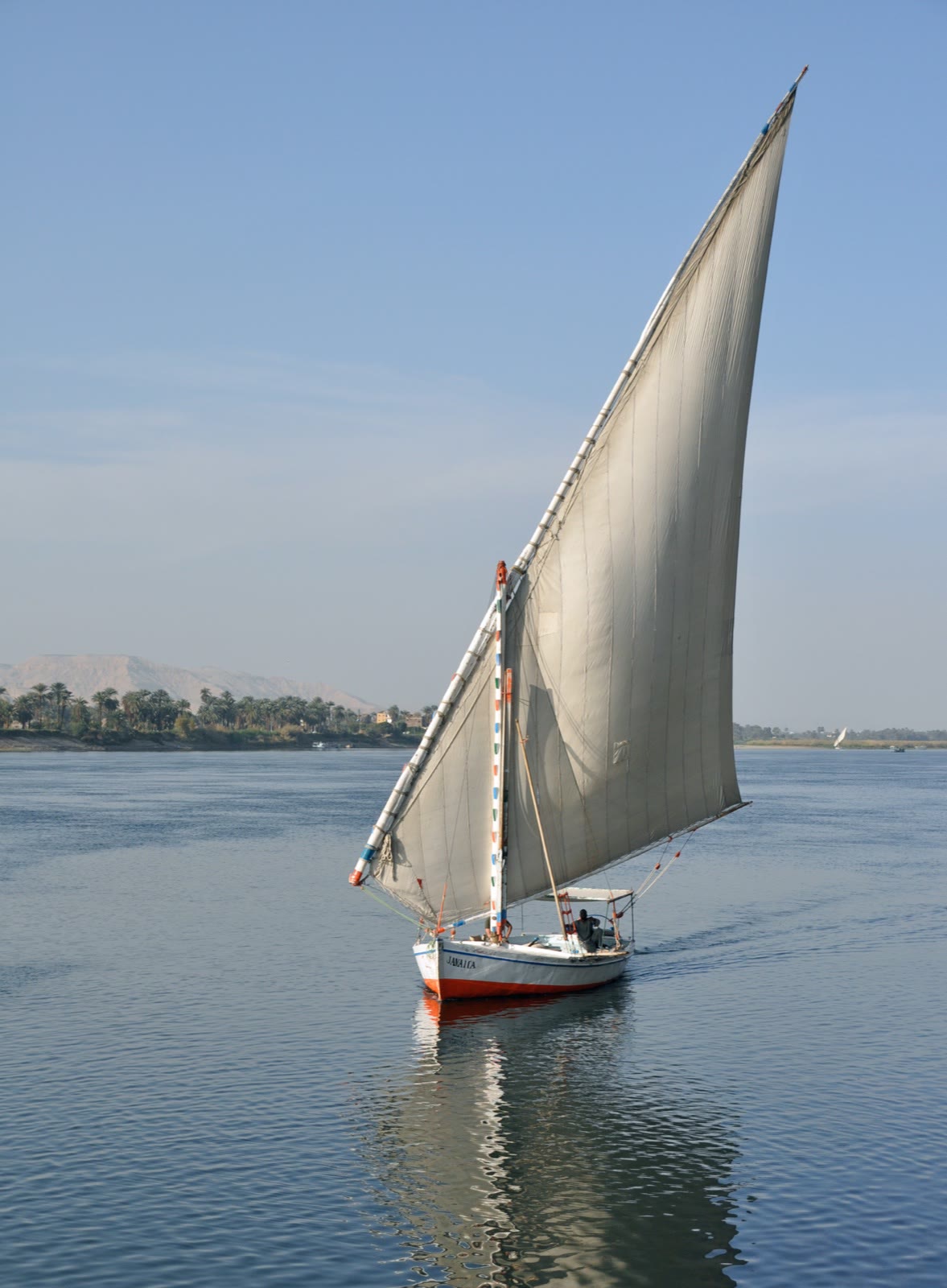

A lateen sail is broadly recognisable by its triangular cloth carried from a long yard set obliquely across a mast. That description is a useful starting point, not a complete specification for every felucca. Proportions, construction, rigging details and local practice vary. From shore, the most reliable method is therefore structural: identify what can be seen, notice how the parts relate and leave hidden controls or operating decisions unnamed.
Find the mast, then the yard
The mast is the more upright support rising from the hull. The yard is the much longer spar that carries an upper edge of the sail and often extends well above or beyond the mast. In a distant view, the two may visually cross into a single dark line. Trace each from one end to the other before describing the rig. A photograph made from an angle can also foreshorten the yard, making a long spar look surprisingly compact.
The yard’s angle is visually dramatic, but it is not a compass needle. Perspective, the boat’s heading and the sail’s position relative to the viewer all affect the image. Two boats on different courses can produce similar triangles from one bank, while the same boat looks different as it passes.
Read cloth as a changing surface
Next, follow the three edges of the sail. Look for a full curved surface, a flattened plane, a fluttering edge or folds gathered near a spar. A filled sail indicates pressure across the cloth, but one still photograph cannot establish steady wind or exact speed. Cloth continues to move between frames, and part of the sail may be sheltered by buildings, trees, islands or the boat’s own geometry.
Five-part shore sketch
Draw the hull as one line. Add mast, yard and the three sail edges. Finish with only the control lines you can actually see. Mark every obscured connection with a break rather than completing it from imagination.
Lines explain control, not decoration
Ropes and lines may raise, support or control parts of the rig. The sheet controls the sail’s working angle, while other visible lines may have different functions. From a photograph, attachment points can overlap and a loose line may be temporarily positioned. Avoid assigning every line a technical name unless its path and use are clear. Never touch rigging on a moored boat or step into the crew’s working space to obtain a closer view.
Reconnect the rig to the hull
The sail does not move independently of the vessel beneath it. Note where the mast meets the hull, where passengers or cargo appear to sit, and which end is the bow only when shape or activity supports the distinction. Paint colour, canopy fabric and decorative finish do not establish the vessel’s age, ownership or condition. A polished tourist-facing boat and a plain working boat can both require precise handling; appearance is not a safety inspection.
Heel—the vessel’s visible lean—can be another clue, but camera tilt and uneven horizons easily imitate it. Compare mast, waterline and a stable building or bank. If the horizon is not trustworthy, describe the angle in the image rather than claiming that the boat was leaning by a measured amount.
Heading is not the complete path
A boat’s bow points in a heading, yet its actual path across the water also reflects current, manoeuvre and changing wind. Shore observers often read only the hull and assume it travels exactly forward. Instead, hold a fixed reference such as a pier, island tip or moored vessel and watch the position change over time. Even then, the exercise remains observation, not navigation: the crew has information about depth, traffic, load and local conditions that a distant viewer lacks.
Notice transitions, not just the perfect triangle
Images often favour a fully spread sail because it makes a clear silhouette. Real operation also includes cloth being eased, shifted, lowered or gathered, and a boat approaching a landing may look less orderly than an open-water postcard. Those transitions reveal coordination. Leave room for hands, lines, deck space and shore helpers in the frame rather than cropping the whole process into anonymous geometry.
End with an evidence-based caption
A strong caption can name a felucca, visible lateen-form sail, broad location confirmed by the source and the relationship of yard to mast. It should not invent wind speed, route, passenger experience, antiquity or a precise manoeuvre. If the file source says Luxor, retain Luxor; if it does not establish a location, do not supply one because the scene looks familiar.
The lateen form remains compelling when described accurately. Its long diagonal yard turns wind into a visible triangle, but the most useful reading keeps that triangle attached to a particular hull, river position and moment. Structure comes first; movement follows only when observation supports it.