Note 02 / river section
Aswan: islands, channels and wind
A broad photograph can look like one sheet of water. Reading foreground, channel, island edge and far bank reveals a more complicated space.
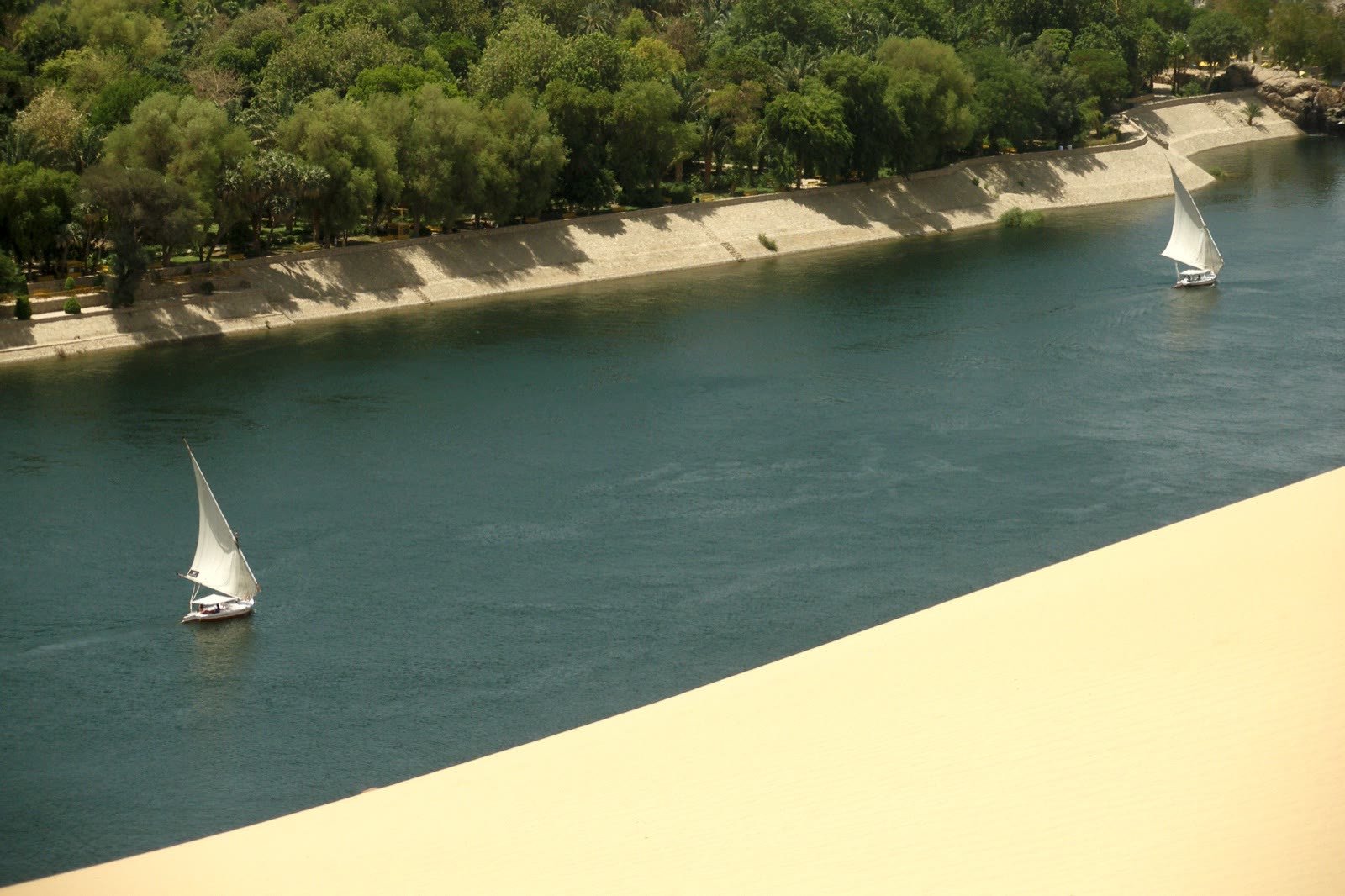

Aswan’s river landscape is often compressed into a single phrase: blue water, granite and sails. A useful field note slows that view down. Islands and exposed rocks divide the visible river into separate passages; near and far banks overlap; trees shelter some surfaces while open gaps expose others. A felucca belongs to one of those passages at a specific moment, not to an abstract background called “the Nile.”
Build the section from front to back
Begin at the observer’s edge. Record whether the foreground is a promenade, landing, garden, wall, boat or open water. Then identify the first navigable-looking gap, the nearest island or rock line, the next band of water and the far bank. Atmospheric haze and telephoto compression can make those layers appear adjacent even when substantial water separates them.
Use overlap rather than guessed distance. A mast disappearing behind foliage establishes that the boat lies beyond that edge; a sail covering part of a bank lies in front of it. These simple relations produce a more defensible map than estimating metres from an unfamiliar viewpoint.
Islands reshape visible wind
Wind clues can differ across the same frame. Open water may show fine ripples while a surface close to a tree-covered bank looks smoother. A sail can be full in one gap and slack nearer a sheltered edge. The downwind side of an obstacle is often described as lee, but a photograph does not always establish the true wind direction or the obstacle’s full shape. Use “sheltered-looking water” when the evidence is incomplete.
Four-band Aswan sketch
Label: observer edge → near channel → island or rock → farther channel and bank. Add each boat only after the bands are fixed. Use arrows for observed movement over time, not for a direction inferred from a single bow.
Current does not announce itself everywhere
Surface texture may reflect wind, vessel wake, current interaction or a combination. Smooth water is not proof of no current, and a bright line is not automatically a rapid. Watch floating material, repeated wake patterns or a boat’s position against a fixed point when observation is safe and permitted. Even those clues do not provide depth or a navigable route.
River levels and operating conditions change. Windward Nile does not convert historical photographs into current channel advice. Only responsible operators and relevant authorities can assess the route at the time of travel.
Crossings create more than one line of movement
Feluccas share the river scene with other craft and with landing approaches that may cut across a viewer’s imagined “main” direction. A ferry, motorboat or service vessel can follow a different line and create wake that reaches a sailing boat later. Photographing only the sail may remove the traffic context that explains a turn or a pause.
From shore, leave working landings clear. The open strip beside water may be needed for boarding, carrying supplies, handling lines or moving between vessels. Do not step onto a narrow dock for a higher camera angle unless it is a confirmed public position.
Use the sail as one weather clue
A full sail shows that the cloth is under pressure, but compare it with water texture, flags, smoke, tree movement and other sails. Each clue responds differently and may sit in a separate wind pocket. A telephoto frame can place several boats side by side even though each occupies another channel or distance.
Lighting complicates the reading. Backlit cloth may reveal folds clearly while hiding the hull; glare can erase fine ripples; a dark bank can make a white sail appear brighter and larger. Record the direction of light when it changes which evidence is visible.
Scale comes from relationships
People, known building elements and repeated boats provide approximate scale, but distance alters them. Do not call one island small because it occupies little of the photograph, or a sail enormous because it dominates the foreground. A sequence of wide, middle and detail frames preserves scale better than a single tightly cropped image.
Keep the river contemporary
Feluccas carry historical associations, yet every visible trip occurs among present-day landings, engines, phones, regulations, livelihoods and visitor expectations. Avoid captions that place the entire scene “outside time.” Traditional form and contemporary operation can coexist without requiring the boat to represent an unchanged past.
An honest Aswan note ends where direct observation ends. It can map bands of water, visible shelter, sail shape and crossings. It cannot promise today’s wind, channel, fare or departure. The divided river is most informative when its layers remain specific.